 +
+
TikTok product research for high-shipping-cost items needs a different order of operations. A product can have strong videos and visible sales while still losing money after freight, storage, damage, returns, and creator samples. This guide is for Amazon, Shopify, and TikTok Shop sellers considering bulky, fragile, heavy, or low-price items. You will get a margin-first scorecard, a fan-category case, and stop rules that prevent social proof from outrunning logistics.
Estimate landed and return costs before treating TikTok demand as an opportunity. Five checks follow. The product needs enough margin and clear camera proof. It also needs creator supply, demand beyond one spike, and a plan for damage and returns. If the economics fail, more content only scales the loss.
The product on a TikTok screen has no carton, warehouse fee, or return label. Your business does. The first calculation is the full cost of one delivered order. It includes the product, inbound freight, duty, packing, platform fees, delivery, creator costs, expected returns, and a damage allowance.
A conservative selling price gives the test a safer base. A coupon is not permanent margin. A fragile or bulky item needs at least three cases: a normal delivery, a discounted sale, and a returned or damaged order. A product that works only in the best case is not ready for inventory.
Carriers often charge for space as well as weight. FedEx explains this in its dimensional-weight guidance. Your contract may use different rules. The useful measurement is the packed carton, not the size shown on a supplier page. Quotes should cover the delivery zones you expect to serve.
| Cost line | Seller input | Why it matters |
|---|---|---|
| Landed product | Unit, freight, duty, packaging | Sets the real inventory basis. |
| Outbound delivery | Billable weight, zone, surcharge | Bulky items can exceed product cost. |
| Acquisition | Commission, sample, ad, discount | Social demand is not free. |
| Returns and damage | Rate, label, write-off, refurbishment | Large products are expensive in both directions. |
| Contribution margin | Net revenue minus variable costs | Funds support, overhead, and growth. |
Value density means how much buyer value and gross profit fit inside the shipping burden. A small fan may sell for less, but it is easy to ship, sample, and demonstrate. A tower fan may support a higher price, but it requires more space, protection, and delivery cost. TikTok evidence helps you see whether the buyer understands the higher-value job.
The best demonstrations make the size worthwhile. They may show quiet bedroom use, whole-room airflow, a timer, movement, or a clear before-and-after result. If creators can show only that “it blows air,” the product may not earn its freight.
KOLSprite can help you compare exact products, linked video supply, creators, price, and recent public performance. Register for a three-day trial membership.
Start a three-day KOLSprite trial
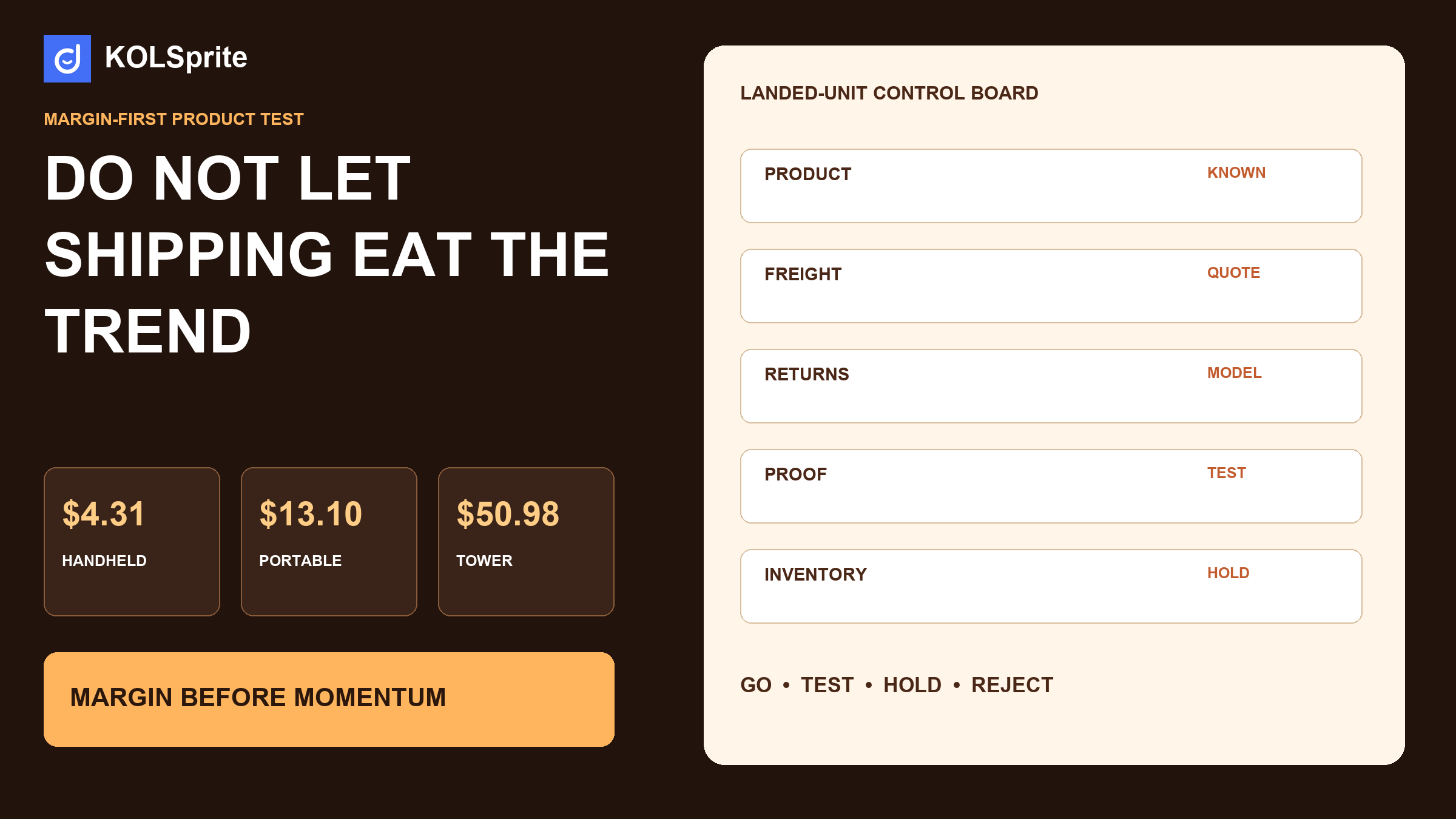
KOLSprite MCP product search for “neck fan” returned several fan formats in the US market on August 5, 2026. A small handheld fan was listed at $4.31 with 20,981 units in the 30-day field, 113 linked influencers, and 138 linked videos. A different handheld model was listed at $13.10 with 21,320 units, 76 influencers, and 118 videos. These are compact items with clear portable use.
The same result set included a tower fan listed at $50.98. Its record showed 19,206 units in the 30-day field, 348 linked influencers, and 1,432 linked videos. The public demand and content supply looked substantial. Yet the product’s size, packaging, delivery, damage, and return cost were not available from the MCP. Those missing inputs are exactly why the seller cannot call it a winner from TikTok data alone.
Several mature fan records also showed negative 30-day growth. Newer low-price handheld products showed sharp gains. Those rates can swing when the earlier period was small, and summer demand changes quickly. This snapshot is a shortlist signal, not a forecast.
Research note: one scoped KOLSprite US product-search page, accessed August 5, 2026. Prices and public performance fields may change. Search results included several fan formats. Shipping, margin, returns, inventory, ad cost, and causal demand were not available.
Public signal: meaningful recent units and broad creator/video supply. Proof job: show room use, noise, controls, and airflow in a realistic space. Missing economics: billable weight, damage rate, return cost, sample cost, and discount margin. Decision: hold inventory; request logistics quotes and run a small content-and-landing-page test first.
The card does not reject the tower fan. It prevents a social signal from becoming a purchase order before the cost model is complete. A hold is a productive decision when it names the proof still needed.
Put both products on one sheet. The handheld fan solves personal cooling. It can be shown in a commute, a makeup routine, or a small desk. The tower fan solves room cooling. It needs a larger scene and a stronger reason for the buyer to accept the size.
Now compare the shipped contribution, not only the selling price. Add sample cost per usable creator asset. Add the cost of a failed delivery. Add the likely discount. A higher price can create room for freight, but it can also raise return cost and buyer expectations. The comparison is complete only when both products use the same cost rules.
The required facts are packed length, width, height, and weight. The team also needs to know whether the carton survives normal handling, where replacement parts will come from, and what happens to a returned unit. These facts are basic, but social-research teams often receive them too late.
Each missing fact needs an owner and a date. “Need shipping details” is easy to ignore. “Operations will confirm billable weight and Zone 8 cost by Friday” can hold a purchase order. A named owner turns uncertainty into work.
Failing the first two gates should stop inventory. The later gates can justify a research or content test, but they cannot repair negative unit economics.
KOLSprite Product Search helps compare exact TikTok Shop products. The view can include prices, recent public sales fields, creator counts, and linked video counts. Video Search then shows whether content proves the value that must cover shipping. Creator research comes later, once the demonstration job is clear.
KOLSprite does not calculate your landed cost, carton size, Amazon fee, Shopify fulfillment rate, or return loss. Those inputs belong in the seller’s model. The product signal tells you what deserves a quote and a test. The margin model decides whether the item deserves stock.
Share an anonymized margin card with the shipping input you still need. Other operators can help question the proof job without asking for private supplier terms.
 +
+
Join the KOLSprite Discord community
For a high-cost sample, use one or two creators who can perform the exact proof. Give them a clear product boundary and collect raw observations before a full campaign. A bulky product does not need fifty generic unboxings. It needs a few credible answers to the buyer’s hardest questions.
Pair the content test with a page that states dimensions, delivery expectations, setup, noise, returns, and fit. Track qualified clicks, add-to-cart behavior, buyer questions, and return-risk signals. Do not judge the test only by views.
The project stops when contribution margin falls below the floor after a normal discount. It also stops when the package fails a repeatable delivery test, the strongest content promise cannot be verified, or demand depends on one creator. A short seasonal window is another stop when inventory cannot arrive in time.
Hold when the public signal is strong but logistics are unknown. Test when the margin has room and the proof job is clear. Scale only after delivered orders confirm the model. This language keeps the team from treating every unknown as optimism.
Your one-page memo should show the exact product and selling price. It should also show margin cases, shipping assumptions, the public TikTok signal, the proof job, the creator plan, risks, and the next gate. Every number needs a source and date. Every unknown needs an owner.
Assume the tower fan has strong public sales and many videos. The shipping quote is still missing. The team should not write “go.” It should write “hold for quote.” The next step is small. Measure the carton. Ask for three delivery zones. Add the expected return label. Then run the margin again.
Now assume the compact fan has lower selling price but cheap delivery. The product is easy to show. A sample can move fast. The team may choose a test. It can order a small quantity, use two proof-led creators, and set a margin floor. This is not proof that the compact product is better. It shows that the unknowns are cheaper to resolve.
Every public metric should have a source. Every shipping cost should have a quote. Every product claim should have a test date. One color can mark known facts and another can mark open items. A weak case should never disappear inside an average.
A reviewer outside the research team should be able to see why the product is a go, test, hold, or reject. That person should also be able to name the next owner. If either answer is unclear, the memo needs less jargon and a sharper choice.
Good TikTok product research for high-shipping-cost items is not anti-growth. It is a way to spend growth money on products that can survive delivery. Use the TikTok Shop versus Amazon guide when platform economics differ, and the Amazon-to-TikTok workflow when you already have reliable marketplace cost and return data.
Latest Articles

As an essential, data-driven toolkit for TikTok influencers and marketers, KOLSprite provides powerful features for effortless creator discovery, trending content identification, and actionable real-time insights.
It empowers users to make smarter decisions and significantly boosts their TikTok business.

 Refer & Earn